
Share
There's a certain drawer in a lot of houses. Junk drawer, desk drawer, the shallow one in the hall closet. And in it, mixed in with dead batteries and mystery keys, are a few tapes about the size of a matchbox.
Microcassettes. The tapes from answering machines and pocket dictation recorders. And here's what makes them different from every other format we cover: they weren't made for movies or music. They were made to record people talking.
Grandparents telling family stories. A dictated letter that never got typed up. Old lectures, interviews, sermons, a business meeting from 1988. And the big one, answering machine tapes, which for some families hold the only surviving recording of a loved one's voice.
If that drawer is in your house, this one's for you.
The Mystery Tape Problem
The most common microcassette story is the estate box: someone cleans out a family home, finds a handful of unlabeled tapes, and has no idea what's on them, because nothing in the house plays them anymore. Those tapes then sit for another decade, unheard.
Treat every mystery tape as irreplaceable until it proves otherwise. The one labeled nothing at all might be the one with your dad's voice on it.
Finding a Player (the Junk Drawer Comes First)
Nobody makes a good microcassette recorder anymore, and the collector consensus is clear: a vintage machine beats a cheap modern replacement, better transports, better heads, better motors. Check your own drawers and your relatives' first; these little recorders have a way of surviving.
Buying? The shortlist: Olympus — they invented the format in 1969, and their Pearlcorder machines have the best reputation, and Sony, reliable and easy to find. Panasonic units and old office Dictaphones are solid too, and office liquidations sell barely-used ones cheap. Tested working units run about $25-80 on eBay; thrift stores turn them up for $5-20.
Two buying rules. First: "powers on" means nothing, you want play, rewind, fast-forward, the speaker, and the headphone jack all confirmed. Second: open the battery compartment before you pay. Leaking batteries have killed more of these recorders than age ever did.
The Chipmunk Problem (It's Not Broken)
Here's the thing that catches almost everyone. Microcassettes record at two speeds — a standard one and a half-speed setting that doubled recording time. Most recorders have a tiny speed switch, and if it's set wrong, the voice comes out as either a chipmunk or a slow-motion giant.
Nothing is damaged. Flip the switch. If a voice ever sounds strange, try the other speed before you worry. (Answering machine tapes are the exception, some machines used their own odd speeds, and the most faithful playback can come from the same type of answering machine that recorded them.)
Before You Press Play
The one horror story every audio forum shares: an irreplaceable tape goes into an untested machine, and a hardened rubber roller chews it on the spot. All of it preventable with a $2 sacrifice.
So: prove the player with a blank or disposable cassette first. Then inspect the family tape, cracks in the shell, mold, moisture, and check that the little pressure pad behind the tape is still there. Play a few seconds, confirm the speed sounds right, then rewind and capture the whole thing in one clean pass. These tapes are thin; every extra play adds wear.
Saving the Voice
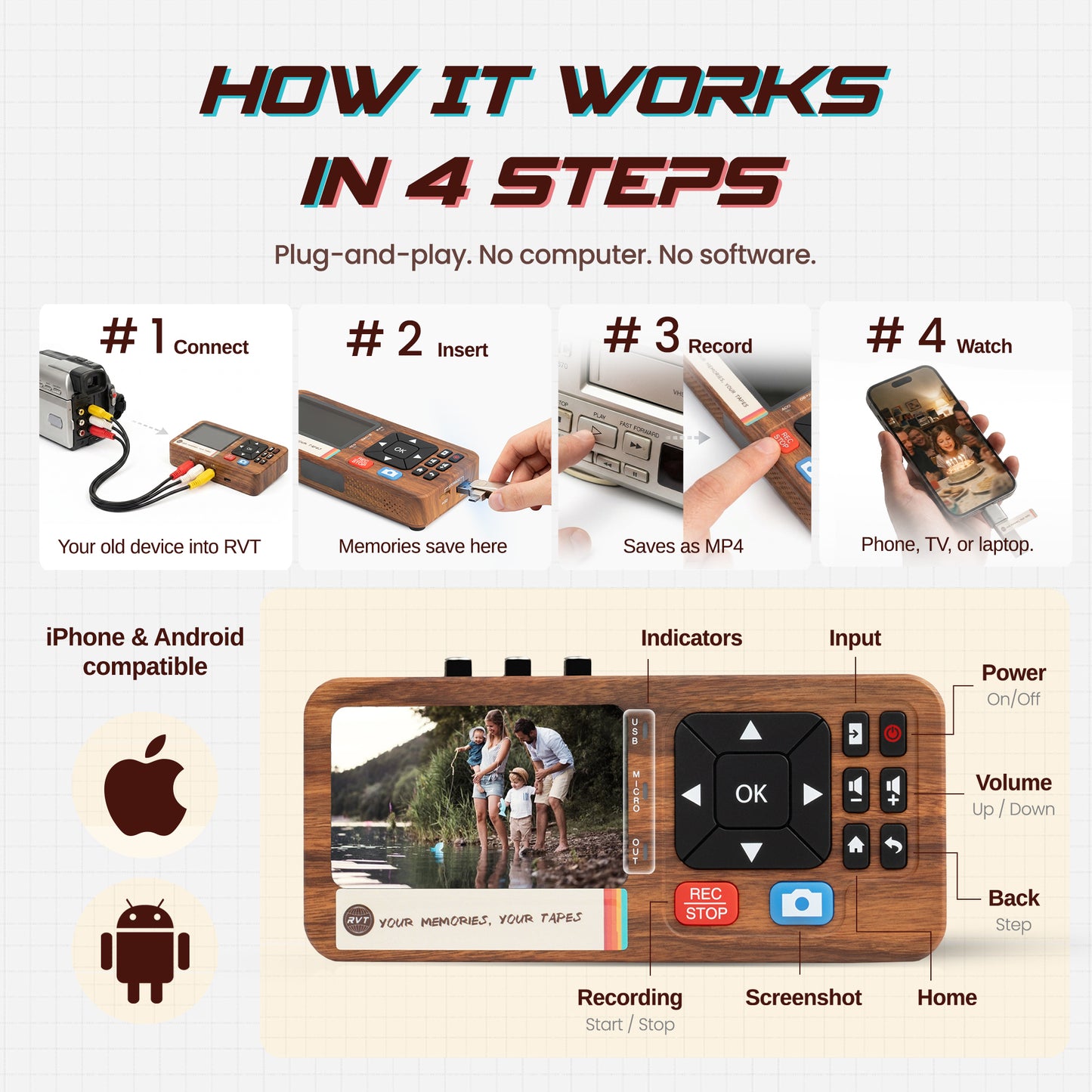
The capture is the easy part. Nearly every microcassette player has a headphone jack, and a 3.5mm-to-RCA cable (a few dollars anywhere) runs straight from that jack into the RVT Digitizer 3.0's red and white audio inputs. Press play on the recorder, press record on the Digitizer, set the volume around halfway, and the voice becomes a file, one you can put on any drive, play on any phone, and send to every relative who'd want to hear it.
And the whole story, as always: audio archivists prefer capturing to an uncompressed WAV file on a computer with recording software, keeping that as a master. It's a good path if that's your comfort zone. The one-cable route is for everyone else, the people who just want grandma's voice saved this weekend.
Name Them Like They Matter
"1994. Grandpa telling the Normandy story.mp4" will stop someone's scrolling thumb in thirty years. "REC_003" won't. Label the files with who's speaking, when, and about what, while someone who remembers is still around to tell you. Keep copies in two places, keep the original tapes cool and dry, and share the best ones with the family. That's the whole point.
The full walkthrough, player buying table, the speed switch, first-play safety, troubleshooting, is free in the Learn Center: Microcassettes: The Complete Playback & Preservation Guide.
Your memories. Your tapes. Digitize everything, regret nothing.